
Most people are not afraid of rehab. They are afraid of the first few days of it.
The rest is abstract. The first week is the part you have to physically walk into, in a country you have probably never visited, without knowing what the building looks like, who will be there, or what will be asked of you in the first hour.
So here is the honest version. Not a brochure day, but the actual sequence of the first seven days at The Dawn Rehab in Thailand, including the parts that are uncomfortable. It is more structured than most people picture, and gentler.
What happens on your first day at rehab in Thailand?
You are collected from the airport and driven straight to the centre. There is no queue, no waiting room, and nothing to arrange once you land. Someone from our team meets you at Chiang Mai International Airport and takes you to us directly, arranged as part of our admission process.
What happens in your first hour at The Dawn
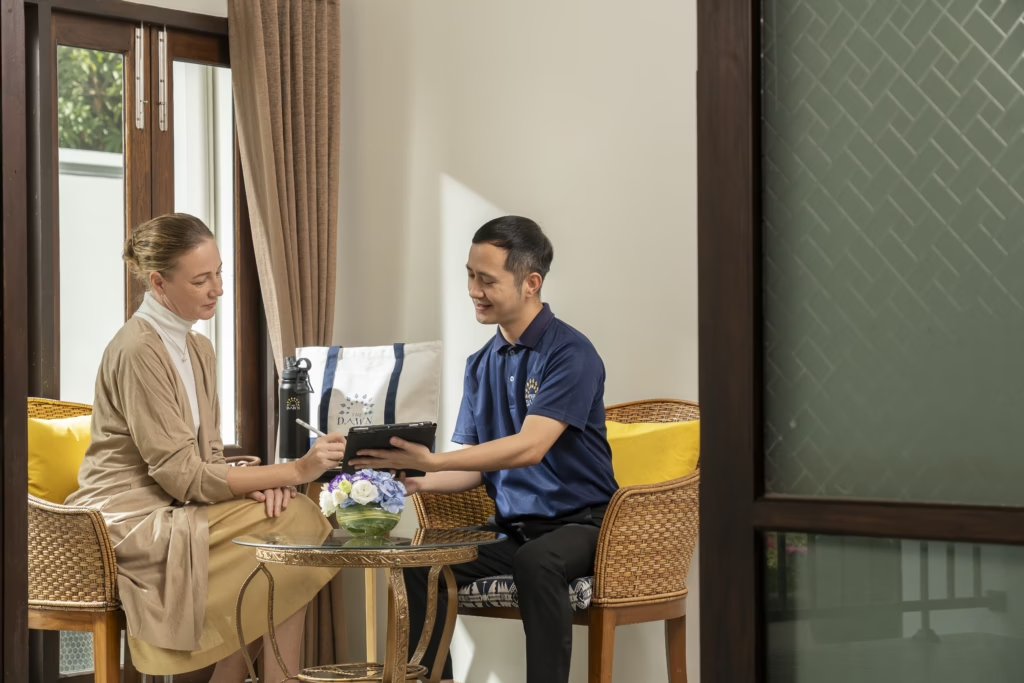
You are not left to work anything out for yourself. Our Support Team will take you through the intake process.
They confirm your identity and emergency contact, go through your current health, medication and anything needing immediate attention, and take an inventory of your medication and anything going into secure storage. There is also a search of your luggage and belongings at admission, which applies to everyone and exists so that nothing comes onto the site that puts you or anyone else at risk.
Most of the paperwork is already done by this point. The agreement, the consent forms and the registration form are all sent to you before you travel, so the first hour is a matter of confirming what you have already read rather than signing a stack of documents while exhausted.
Then you are shown your room and around the centre, introduced to the people you will be seeing every day, and told the practical things: who to find if you need something, what happens in an emergency, and how the day is structured.
Nobody asks you to be sociable on day one, and nobody expects you to have anything figured out. Most people arrive exhausted, and once orientation is done the priority is that you rest.
You will meet the people responsible for your care rather than being handed a folder. That includes the nursing team who will look after you through withdrawal and the therapist you will be working with.
Phones and laptops are not confiscated. You can use them in a way that does not intrude on other clients, and your own treatment plan may add limits, which your team explains and reviews with you rather than imposing without discussion.
Your rehab intake assessment: how your addiction treatment plan is built
Your plan is built from an assessment that starts before you arrive and finishes in your first days here. Our clinical team completes a preliminary assessment during admissions, so we already know your history, your medical situation and what you are hoping to get out of this before you land.
The full on-site assessment begins shortly after you arrive.
You are assessed across four areas: your substance use history and pattern, your physical health and what withdrawal is likely to look like for you, any mental health condition running alongside the addiction, and what you actually want your life to look like afterwards. Your treatment plan is built from those findings.
That last one matters more than people expect. Two clients with identical drinking histories get different plans if one wants to save a marriage and the other wants to keep a career. The Treatment Roadmap sets the three phases, but what happens inside them is decided here.
Because a majority of people arriving for addiction treatment have a co-occurring mental health condition, the assessment looks for it whether or not you have mentioned it. If something is found, it is treated alongside the addiction through our dual diagnosis programme rather than referred elsewhere.
What does drug and alcohol detox feel like in a rehab in Thailand, and how are you kept comfortable?
It is manageable, and you are not doing it alone. Medically supervised withdrawal is the first phase of treatment, and it runs with nursing care available around the clock.
What withdrawal actually involves depends on the substance and on how long you have been using. Alcohol and benzodiazepines carry the most physical risk and are the reason unsupervised detox can be dangerous. Stimulants and ketamine tend to be psychologically harder than physically dangerous, with heavy fatigue, low mood and disturbed sleep. Opioids sit somewhere between the two.
In every case the approach is the same. Through medically supervised detox, you are assessed for what you are likely to experience, monitored throughout, and given medication where it is needed to keep you safe and as comfortable as possible. If something changes, someone is there at three in the morning to notice.
Most people describe the first two or three days as the most challenging, then a noticeable turn. Sleep starts returning first, usually before mood does.
When does addiction therapy start in rehab?
Sooner than most people expect, and gently. You are not left sitting in a room until detox is over. Therapy begins as soon as you are well enough to take part, which for most people is within the first few days.
Early sessions are not intensive trauma work. That only comes later when you have the stability to handle it. The first week is about getting to know your therapist, settling into the rhythm of the day, and beginning the work of understanding what has been driving the use.
| What the first week includes | What it is for |
|---|---|
| Individual sessions with your therapist | Building the relationship the rest of your treatment depends on, and starting to map what sits underneath the addiction. |
| Group therapy | Being around people in the same position, which for most clients is the first time in years they have not had to explain themselves. |
| Wellness sessions | Yoga, breathwork, sound therapy and bodywork, which sound peripheral until you have not slept properly in months. |
| Fitness and daily routine | Restoring sleep, appetite and structure, which is a bigger part of early recovery than most people credit. |
A full week runs to around fifteen hours of group therapy alongside your individual sessions. You can see how the days are structured on our typical weekly timetable.
What daily life in a rehab in Thailand looks like by day four or five Ordinary, which is the point.
By the middle of the week the days have a shape: you get up at a set time, you eat proper meals, you have sessions to be at, and you sleep at night.
That structure does more work than it appears to. Addiction erodes routine long before it erodes anything visible, and a great deal of what feels unmanageable at home is the absence of any fixed points in the day. Having them handed back to you, without having to build them yourself while feeling terrible, is a large part of why the first week works.
You are also living alongside a small group rather than a crowd. We take a maximum of 30 clients at a time, which means by the end of the first week you know everybody’s name and the staff know yours.
How will you feel by the end of your first week in a drug and alcohol rehab in Thailand?
Physically better than when you arrived, and usually surprised by that. Sleep has begun to return, the acute part of withdrawal is behind you, and the constant low-level management of the addiction has stopped taking up every hour.
Emotionally it is less tidy. Many people describe a flatness or a raw feeling in the second half of the first week, which is normal and expected. You have removed the thing that was managing your feelings, but the feelings are still there. That is precisely what the following weeks are for.
What has changed by day seven is that you are stable enough to start the real work. Phase one exists to get you to that point. Phase two, managing triggers and cravings, is where treatment actually begins.
The first week is rarely what people picture. Most clients arrive braced for something punishing, and what they find is that a lot of it is just rest, food and sleep, with people checking on them. What I notice most is the shift around day four or five, when someone has slept properly for a few nights and their thinking starts to clear. They often say it is the first time in months they have not felt like they were managing something.

Why people choose The Dawn over other rehabs in Thailand
Nobody is left alone with withdrawal. Nursing care is available around the clock through the first phase, and medication is used where it is needed rather than as a matter of course.
Independently audited treatment standards. We are the only CARF-accredited residential rehab in Asia, the same accreditation held by leading treatment centres in the United States, and we are separately accredited by the Thai Ministry of Public Health.
A small centre rather than a large one. A maximum of 30 clients means the team knows you rather than your file.
A plan built from your assessment. What happens in your first week is shaped by what the assessment finds, including anything running alongside the addiction.
Take the first step towards rehab in Thailand
The Dawn Wellness Centre and Rehab treats addiction and co-occurring mental health conditions for clients from around the world, at a peaceful riverside property just outside Chiang Mai, in northern Thailand. We have been doing this since 2017, with over 1400 success stories, we take a maximum of 30 clients at a time, and our therapists are certified in the UK, the US and Australia.
If the first week is the part putting you off, it is worth saying that almost nobody finds it as bad as they expected. Most people say afterwards that the waiting was worse than the arriving.
Our admissions team can talk you through exactly what your first week would involve, what to bring, and how the travel works.
Speak to our admissions team in complete confidence.
Frequently asked questions
Contact with family is usually limited during the first week and is agreed with your therapist at intake.
The reason is not secrecy. The first week is when you are least well and most likely to want to be talked out of staying, and a period of separation gives you the space to get through it. Family contact typically opens up as you stabilise, and we can keep your family informed in the meantime.
Less than you think. Comfortable clothes for a hot climate, anything you need for exercise, and any prescribed medication in its original packaging to be checked in with the medical team. Our admissions team sends a full list before you travel, and anything you have forgotten can be bought locally.
Almost everybody thinks about it, usually around day three. It is such a common pattern that your therapist will likely raise it before you do. You are not held anywhere against your will, but you will be asked to talk it through first, because the urge to leave is nearly always the withdrawal talking rather than a decision.